If you run a Cisco Meraki network, you already know the feeling: the kit works well, the dashboard is genuinely slick, and then the renewal quote lands and you remember that none of it is really yours. Every access point, every switch, every security appliance carries its own licence, and those licences never stop. Miss a renewal and the dashboard locks you out and the hardware stops being managed. It’s a rental you can’t switch off.
There is another way, and it’s one we roll out for clients all the time: Ubiquiti UniFi. It gives you enterprise-grade Wi-Fi, switching and routing with no per-device licensing at all. You buy the hardware once, manage it from a controller you own, and the annual licence bill simply disappears.
To help you see the difference in pounds rather than promises, we’ve built a free tool.
Try the calculator
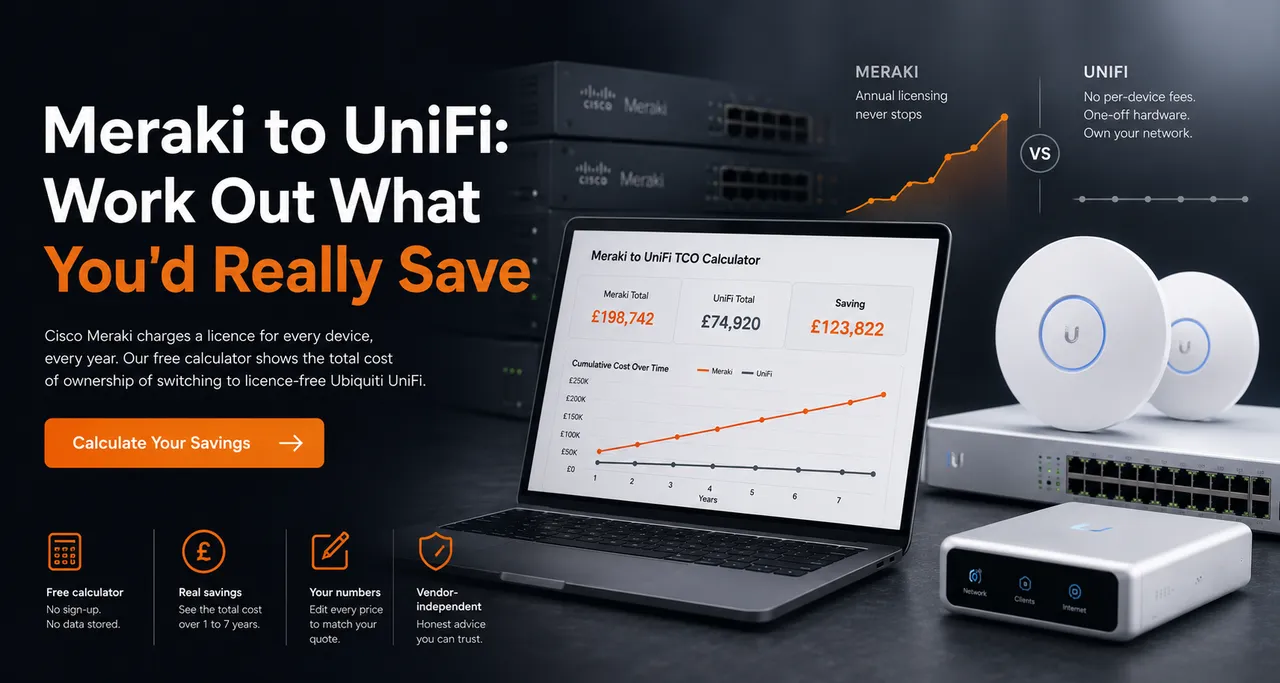
Our Meraki to UniFi TCO calculator lets you enter your estate — access points, switches, security appliances — and projects the total cost of ownership of staying on Meraki versus switching to UniFi over one to seven years. Every price is editable, so you can drop in your own renewal quotes and hardware figures for a number you can actually trust. It runs entirely in your browser, with no sign-up and nothing stored.
It even accounts for the honest bits: the cost of the UniFi hardware, a controller, and Next2IT doing the rollout for you. The saving you see is the saving after all of that.
Why the maths usually favours UniFi
The headline isn’t the hardware price — it’s the recurring licence fee.
Meraki licences never stop
With Meraki, licensing is mandatory and ongoing. One year might feel manageable. But networks live for a long time: a typical refresh cycle runs five to seven years. Multiply every device’s licence by every one of those years and the figure climbs quietly but relentlessly.
UniFi has no per-device licence
UniFi is licence-free. You host the controller yourself, or run it on an inexpensive Cloud Key or gateway — a one-off cost, not an annual one. There’s no per-device fee waiting to catch you at renewal.
The gap compounds
Because one side keeps paying and the other doesn’t, the difference grows every single year. For most SMEs and mid-market organisations, switching to UniFi pays for itself well inside the first refresh cycle, even after paying us to design and deliver the migration.
We’re vendor-independent, so this isn’t a sales pitch dressed up as advice. Meraki genuinely suits some very large, highly distributed estates, and if it’s the right fit for you we’ll say so. But for the majority of businesses, UniFi does the same job for a fraction of the lifetime cost.
Switching sounds daunting. It isn’t when we do it.
The usual worry isn’t the saving — it’s the disruption. Changing your network vendor feels like open-heart surgery on the thing everyone relies on. In practice, a well-run migration is calm and largely invisible to your team. Here’s how we handle it:
- Survey and design. We audit your current Meraki estate, map coverage and capacity, and design a like-for-like (or better) UniFi network.
- Stage and configure. We pre-build your UniFi kit — SSIDs, VLANs, firewall rules, VPN — replicating your existing policies so nothing behaves unexpectedly.
- Cut over. We swap the hardware in a planned window, often out of hours, and validate every site before we sign off.
- Support and monitor. Losing the Meraki cloud dashboard doesn’t mean losing enterprise support. Our 24×7 Network Operations Centre keeps watch, handles firmware and changes, and is on hand whenever you need us.
It sits within our wider network remediation and managed IT support work, so you get the managed experience without the per-device licence bill.
Run your numbers, then let’s talk
Have a quick play with the savings calculator using your own device counts and, if you have it, your latest Meraki renewal quote. If the figure makes you sit up, that’s the point.
When you’re ready for a firm number, get in touch. We’ll model the exact saving for your estate, design the UniFi replacement, and handle the whole rollout — with round-the-clock support once you’re live. Tech you can trust, people you’ll like, and a network you actually own.